
A 5-Day Fall Unit Study for Homeschoolers (Ages 6-9)
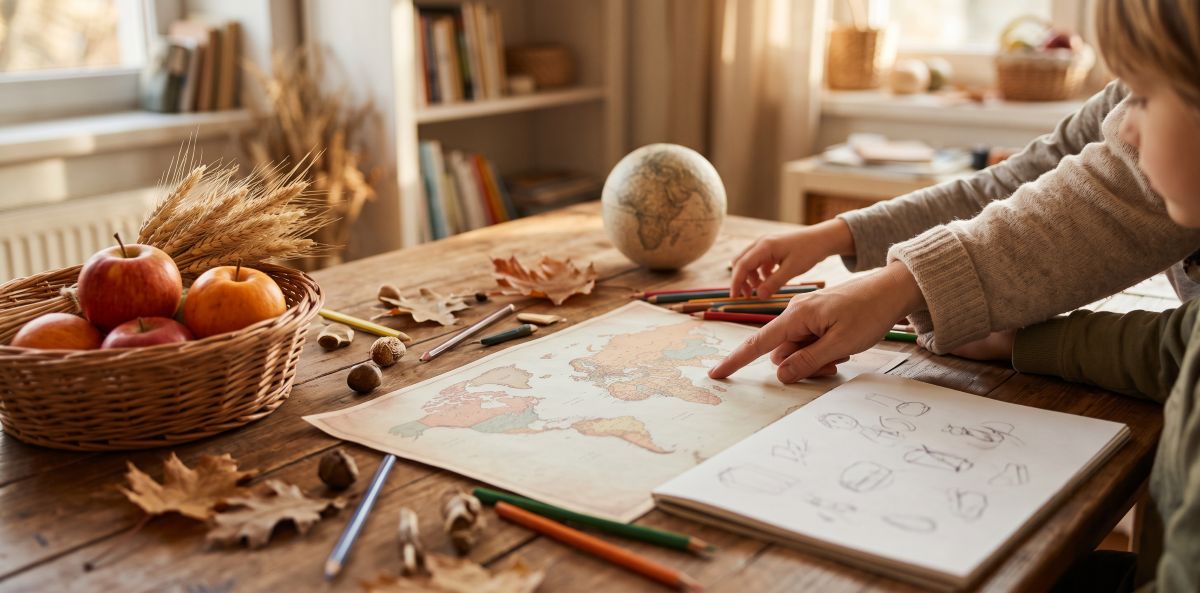
Quick answer: This is a 5-day fall unit study for homeschoolers aged 6 to 9, about 30 to 45 minutes a day. Day 1 explains why the seasons change, Day 2 puts harvest and remembrance festivals on a map, Day 3 is a fall food activity, Day 4 is a lantern craft and a talk about remembering loved ones, and Day 5 is a family show-and-tell. You need paper, pencils, a world map or globe, and optional library books. Nothing here is a promise of learning outcomes; these are activities that many families find enjoyable, and you can stretch or shorten them to suit your child.
Fall is a natural time for this kind of unit. The weather changes, harvest food is in the shops and many cultures mark the season with festivals. For the festivals themselves, see our guide to 10 fall festivals around the world; this plan shows how to turn them into a week of lessons.
The week at a glance
| Day | Theme | Main activity | Subject areas |
|---|---|---|---|
| 1 | Why do seasons change? | Tilted-globe demonstration | Science |
| 2 | Festivals on the map | Pin five festivals on a map | Geography |
| 3 | Fall food | Taste, draw and compare a harvest food | Home economics, art |
| 4 | Light and remembrance | Make a paper lantern and talk about memories | Art, social studies |
| 5 | Show and tell | Present what you learned to the family | Speaking, review |
Materials
- A world map or globe, sticky notes or pins
- Paper, pencils or crayons, scissors, glue
- A flashlight or lamp and an orange or ball (Day 1)
- One fall food from your kitchen, such as apples, pumpkin, rice or bread (Day 3)
- A paper bag or sheet of colored paper and a battery tea light (Day 4)
- Optional: Autumn Traditions Around the World for Kids or our free sample
Day 1: Why do the seasons change?
Goal: Understand that the Earth’s tilt, not its distance from the Sun, causes the seasons.
NASA explains that the seasons happen because the Earth’s axis is tilted. When the North Pole tilts toward the Sun, the Northern Hemisphere has summer; when the South Pole tilts toward the Sun, the Northern Hemisphere has winter. Distance does not cause the seasons: the Earth is actually closest to the Sun in January.
Do it:
- Put a lamp in the middle of the room as the “Sun”.
- Tilt a ball or globe and walk it slowly around the lamp, keeping the tilt pointing the same way.
- Stop at four places and ask your child where the light is strongest.
Ask: “Why is it fall in our country but spring in Australia?”
Day 2: Festivals on the map
Goal: Find places on a map and link a place to a tradition.
Britannica notes that harvest festivals are observed worldwide and that their timing varies with climate and crop. Pick five festivals from our festival guide, for example Mexico, Poland, China, Korea and Ghana.
Do it:
- Write each country on a sticky note with the name of its festival.
- Find the country on the map or globe and stick the note on it. Our guide to the seven continents helps younger children.
- Ask which continent each one is on, and which are close to or far from home.
Ask: “What do these festivals have in common?” (Many are about gratitude, family or remembering.)
Day 3: Fall food
Goal: Notice how food connects to season and culture.
Britannica describes feasting as a common theme of harvest festivals. Choose one food from your kitchen or a recipe linked to a festival, such as mooncakes, songpyeon or a simple apple dish.
Do it:
- Look, smell and taste together, then draw the food and write one describing word.
- Ask where the ingredients grow and in which season.
- Compare with a food your family eats in autumn.
Check allergies and food safety first.
Day 4: Light and remembrance
Goal: Practice a calm conversation about family memory and make a simple craft.
Many cultures use lights and flowers to remember loved ones. In Mexico, UNESCO describes families welcoming the souls of loved ones with flowers, candles and offerings, and in Poland families visit cemeteries with lanterns. See our short guides to Día de los Muertos for kids and non-scary Halloween alternatives.
Do it:
- Cut shapes into a paper bag or colored paper to make a lantern, and put a battery tea light inside.
- Ask your child to choose a family member or a pet to remember, and to say one happy thing about them.
- Put the lantern next to a photo for the evening.
Safety tip: Use battery lights, not real candles, with young children.
Day 5: Show and tell
Goal: Review and speak about what was learned.
Let your child present the week to another family member: the tilt demonstration, the map, the food drawing and the lantern. Then ask three questions:
- What surprised you most?
- Which festival would you like to learn more about?
- What would you like to do differently next autumn?
How to check progress without tests
- Ask your child to retell one day in their own words.
- Ask them to find two of the festival countries on the map without help.
- Keep the drawings and map in a folder as a simple portfolio.
If you need to report to your local homeschool authority, check your own region’s requirements; they vary.
Optional: a coloring book to go with it
Autumn Traditions Around the World for Kids is an educational coloring and activity book for ages 6 to 9. It visits 27 countries, with three pages for each: a country and tradition page, a page of symbols and local words, and a scene to color. It can be used as an optional extra for Days 2 to 4. You can find it on Amazon and read more on its book page. To try before you buy, download the six-page free sample PDF.
For map practice, see also Volume 1: Europe in our Children of the World and Their Cultures series, and our article on flags and early map reading.
Disclosure: Alex Herek is the publisher of these books. You can find all titles on the Amazon author page.
Frequently asked questions
How long does this unit study take? About 30 to 45 minutes a day for five days. You can spread it over two weeks.
What ages is it for? It is designed for ages 6 to 9. For younger children, do the activities together and skip the writing; for older children, add research and a short written report.
Do I need to buy anything? No. You need paper, pencils, a map or globe and food from your kitchen. A coloring book is optional.
Can I use this plan in a classroom? Yes, with small adjustments for group size. For classroom ideas, adapt the activities to your group size and available time.
Is it suitable for the Southern Hemisphere? Yes. Day 1 explains why seasons are opposite, and you can adapt the dates to your own season and local festivals.
Key takeaways
- A 5-day plan: seasons, map, food, lantern, show-and-tell.
- Keep it light: 30 to 45 minutes a day and hands-on.
- Check progress by retelling and finding places on a map, not by testing.
- Handle remembrance themes gently and use battery lights with young children.
Sources
- Why do we have seasons?, NASA Space Place (Earth’s tilt, seasons, distance from the Sun).
- Harvest festival, Encyclopaedia Britannica (themes, timing, examples).
- Indigenous festivity dedicated to the dead, UNESCO Intangible Cultural Heritage (Mexico).
- A night of a thousand lights, Warsaw Insider (Poland).
Want to try the Autumn Traditions book?
Grab a free 6-page sample from "Autumn Traditions Around the World for Kids."