
Autumn Traditions Around the World: A Kids' Guide to 10 Fall Festivals
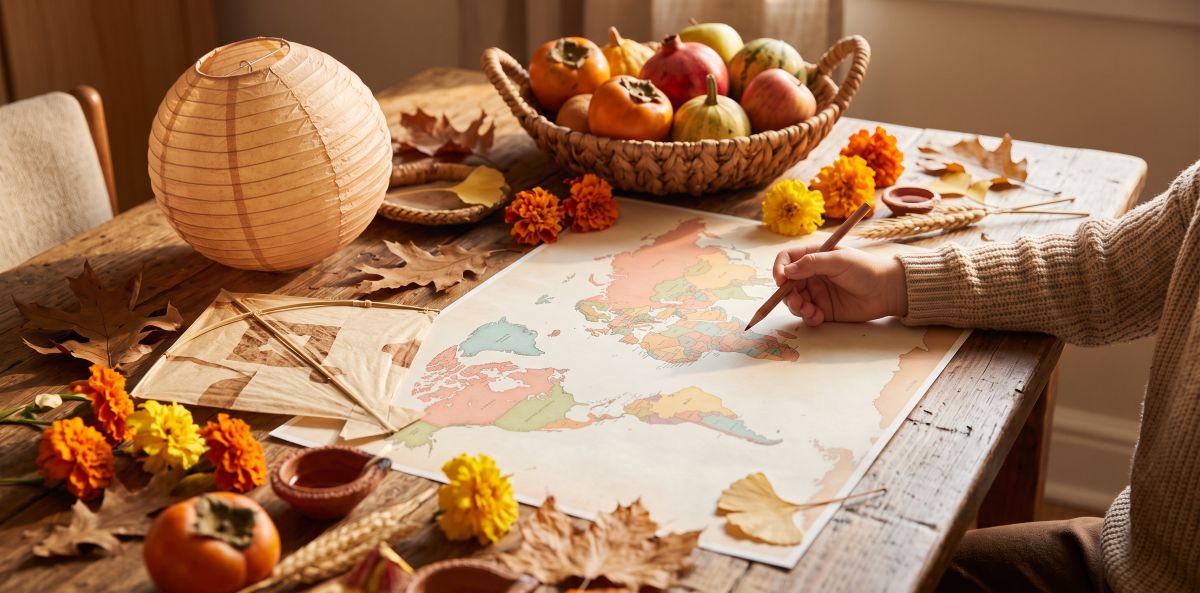
Quick answer: Around the world, families mark autumn with harvest meals, full-moon gatherings, lanterns and kites, and days to remember loved ones. Ten well-known examples are Día de los Muertos in Mexico, the Giant Kite Festival in Guatemala, All Saints’ and All Souls’ days in Poland, Samhain in Ireland, Sukkot in Israel, Thanksgiving in the United States, the Mid-Autumn Festival in China, Chuseok in Korea, Homowo in Ghana and Obon in Japan. Traditions vary by region and by family, so treat this guide as a first introduction to start a conversation, not a complete picture of any country.
Autumn is a good season for this kind of geography lesson. The days get shorter, the harvest comes in and many cultures turn to gratitude and family. Here is how ten of them do it.
10 fall festivals for kids
1. Mexico: Día de los Muertos (Day of the Dead)
In many communities in Mexico, families remember loved ones at the end of October and the beginning of November. UNESCO describes how families welcome the returning souls of loved ones with flowers, candles and offerings. For children, the heart of it is memory and love: telling happy stories, building a family altar and decorating it with marigolds and photos. It is a warm celebration, not a scary one. For simple words to explain it to a child, see our guide to explaining Día de los Muertos to kids.
2. Guatemala: the Giant Kite Festival
Every November 1, All Saints’ Day, the towns of Sumpango and Santiago Sacatepéquez fill with enormous, colorful kites. The giant display kites measure roughly 6 to 20 meters across. Families prepare them in advance, and the kites carry messages to the heavens, thanking ancestors and asking for protection and prosperity.
3. Poland: All Saints’ Day and Zaduszki
In Poland, All Saints’ Day falls on November 1 and All Souls’ Day (Zaduszki) on November 2. Families visit cemeteries at dusk with flowers and lanterns, and the grounds glow with thousands of candles. It is a quiet, family-centered time to remember relatives and friends.
4. Ireland: Samhain
Samhain is an ancient Celtic festival that marks the end of summer and the start of winter. Its name means “Summer’s End” in Irish, and it is celebrated on the evening of October 31 into November 1. Britannica notes that it was believed to be a time when the boundary between the living and the dead grew thin.
5. Israel: Sukkot
Sukkot, also called the Festival of Booths, is an autumn Jewish festival that begins on the 15th day of the month of Tishri, in September or October. It is one of the three pilgrim festivals of the Hebrew Bible and is sometimes described as a “double thanksgiving”. Families build a sukkah, a temporary hut roofed with branches, and spend time in it. The Hebrew word sukkot means “huts” or “booths”.
6. United States: Thanksgiving
American Thanksgiving is modeled on a 1621 harvest feast shared by the Plymouth colonists and the Wampanoag people, and it celebrates the blessings of the past year. Since 1942 it has been held on the fourth Thursday in November, which is November 26 this year. A traditional meal includes turkey, cranberries, stuffing and pumpkin pie. Canada celebrates its own Thanksgiving on the second Monday in October.
7. China: the Mid-Autumn Festival
The Mid-Autumn Festival takes place on the 15th day of the 8th month of the Chinese lunisolar calendar, on the night of a full moon near the autumn equinox. This year it fell on Friday, September 25. Families gather to admire the moon, share round mooncakes that symbolize completeness and unity, and carry lanterns. Related moon and harvest festivals include Chuseok in Korea, Tsukimi in Japan and Tết Trung Thu in Vietnam.
8. South Korea: Chuseok
Chuseok, also called the Harvest Moon Festival, falls on the 15th day of the 8th lunar month. According to Britannica, the day begins with a ceremony offering food to ancestors, followed by a family meal of newly harvested vegetables and grains. The signature treat is songpyeon, a crescent-shaped rice cake. People often wear hanbok, visit family graves and play traditional games.
9. Ghana: Homowo
The Ga people of Ghana celebrate Homowo in August or September, in Ga land in the Greater Accra Region. The name means “to hoot at hunger” and the festival remembers a famine in Ga history. It is a festival of remembrance and community.
10. Japan: Obon
Obon is held in July, or in August in some places, so in Japan it belongs to summer, but the book groups it with the season’s festivals of remembrance. According to Britannica, it is a time when people believe the dead return to the living world: families clean gravestones and light lamps to guide ancestral spirits home, and it is a time for gatherings.
At a glance
| Festival | Country | Main themes | Typical time |
|---|---|---|---|
| Día de los Muertos | Mexico | Memory, flowers, candles | Oct 31–Nov 2 |
| Giant Kite Festival | Guatemala | Kites, ancestors | Nov 1 |
| All Saints’ / Zaduszki | Poland | Candles, remembrance | Nov 1–2 |
| Samhain | Ireland | End of summer | Oct 31–Nov 1 |
| Sukkot | Israel | Harvest, huts | Sept or Oct |
| Thanksgiving | United States | Gratitude, harvest meal | Fourth Thursday of Nov |
| Mid-Autumn Festival | China | Full moon, mooncakes | 15th day of 8th lunar month |
| Chuseok | South Korea | Harvest moon, ancestors | 15th day of 8th lunar month |
| Homowo | Ghana | Remembrance, community | Aug or Sept |
| Obon | Japan | Ancestors, lanterns | July or Aug |
How to explore these traditions with your child
- Pick one festival a week and find the country on a map or globe.
- Cook or taste something linked to it, such as songpyeon, mooncakes or a Thanksgiving side dish.
- Ask a gentle question: “Who in our family would you like to remember?” or “What are we thankful for this autumn?”
- Respect differences. Remind children that families within one country celebrate in many ways, and that some do not celebrate at all.
For families who prefer a calm autumn, our guide to non-scary Halloween alternatives has more ideas, and our article on teaching empathy by meeting children around the world explains why this kind of learning matters.
A coloring trip through 27 countries
If your child likes to color while learning, Autumn Traditions Around the World for Kids is an educational coloring and activity book for ages 6 to 9. It visits 27 countries, with three pages for each: a country and tradition page, a page of symbols and local words, and a scene to color. Many of the festivals above, including Mexico, Guatemala, Poland, Ireland, Israel, the United States, Japan and South Korea, appear in its table of contents. You can find it on Amazon and read more on its book page. To try before you buy, download the six-page free sample PDF.
If your child enjoys flags and maps too, see our Children of the World and Their Cultures series, which includes Volume 1: Europe.
Disclosure: Alex Herek is the publisher of these books. You can find all titles on the Amazon author page.
Frequently asked questions
What are some fall traditions around the world? Harvest festivals such as Thanksgiving in the United States and Sukkot in Israel, moon festivals such as the Mid-Autumn Festival in China and Chuseok in Korea, and remembrance days such as Día de los Muertos in Mexico and All Saints’ and All Souls’ days in Poland.
Are these festivals religious? Some are tied to a religion, such as Sukkot, and some mix religious, family and cultural customs. We describe them informationally and respectfully, and traditions vary within each country.
Is there a lesson plan for this? Yes. See our 5-day fall unit study for homeschoolers, which turns these festivals into a week of lessons.
What age is this guide for? It works well for ages 6 to 9, read together with a parent or teacher. Younger children can enjoy the pictures and the food and craft ideas.
Do all these festivals fall in autumn? Most do, but not all: Obon is held in July or August in Japan, and Homowo is held in August or September. They are included because they celebrate harvest, family or remembrance in the same spirit as the autumn festivals.
Is the book only in English? Yes. Autumn Traditions Around the World for Kids is currently available in English only.
Key takeaways
- Many cultures use autumn for gratitude, harvest and remembering loved ones.
- Moon, lantern and kite festivals link families across Asia and Latin America.
- Traditions vary by region and by family; explore with curiosity and respect.
- Coloring and talking about other countries’ traditions is a calm, screen-free way to enjoy the season.
Sources
- Indigenous festivity dedicated to the dead, UNESCO Intangible Cultural Heritage (Día de los Muertos).
- Giant Kites: Sumpango and Santiago Sacatepéquez, Spanish Academy Antiguena (date, size and meaning of the kites).
- A night of a thousand lights, Warsaw Insider (All Saints’ Day and Zaduszki in Poland).
- Samhain, Encyclopaedia Britannica.
- Sukkoth, Encyclopaedia Britannica.
- Thanksgiving Day, Encyclopaedia Britannica (origin, date, Canada).
- Mid-Autumn Festival, Wikipedia (lunar date, customs, 2026 date).
- Chuseok, Encyclopaedia Britannica.
- Homowo Festival, Ghana Culture (Ga people, meaning, timing).
- Bon festival, Encyclopaedia Britannica.
Want to try the Autumn Traditions book?
Grab a free 6-page sample from "Autumn Traditions Around the World for Kids."