
The 7 Continents for Kids: A Simple Guide for Ages 4–8
Quick answer: There are seven continents: Asia, Africa, North America, South America, Antarctica, Europe and Australia, listed here from largest to smallest. A continent is one of Earth’s seven main divisions of land, and the water that surrounds them is divided into five oceans. For children aged 4 to 8, the easiest way to learn them is to see them, touch them and color them, one or two at a time, rather than memorizing the whole list at once.
This guide gives you the names, one memorable fact for each continent, the five oceans, and five easy ways to practice at home or in class.
The seven continents at a glance
National Geographic Education lists the continents in this order, from the largest to the smallest. Use the table as a quick reference, and pick just one fact per session to share with your child.
| # | Continent | One thing to know |
|---|---|---|
| 1 | Asia | The largest continent |
| 2 | Africa | The second-largest continent |
| 3 | North America | Includes Greenland and the islands of the Caribbean Sea |
| 4 | South America | The fourth-largest continent |
| 5 | Antarctica | The coldest, windiest and driest place on Earth, with no countries |
| 6 | Europe | Shares one big landmass with Asia |
| 7 | Australia | The smallest continent, and the flattest |
A few facts that make the continents memorable
Asia is the biggest. It is the largest of the seven, which makes it a good first continent to find on a globe.
Antarctica has no countries. No one lives there permanently. Scientists and support staff stay for a time, and research stations are run by groups from different countries. A treaty signed in 1959 says the continent can be used only for peaceful research.
Australia is small, flat and dry. National Geographic describes it as the smallest and flattest continent, and the second driest after Antarctica. The Australian continent includes the country of Australia, the eastern part of the island of New Guinea and New Zealand. You will sometimes hear the name Oceania too, which can also include many Pacific islands.
Europe and Asia are really one landmass. Together they form one huge area of land called Eurasia. Geographers still count them as two continents for cultural and historical reasons, with an imaginary line running from the northern Urals south toward the Caspian and Black Seas.
And the five oceans
The continents sit in a single connected body of salt water that covers about 71 percent of Earth. NOAA, the United States ocean agency, explains that this one global ocean has long been divided into named parts. Historically people named four: the Atlantic, Pacific, Indian and Arctic. Most countries today, including the United States, also recognize a fifth, the Southern Ocean, which surrounds Antarctica. NOAA notes that the exact borders of the Southern Ocean are still not formally agreed by everyone.
For young children, a simple way to say it: “The continents are the land. The oceans are the water between them.”
How to teach the continents to ages 4 to 8
- Start with home. Find your own continent first, then your country, then your town. Children learn faster when the map includes them.
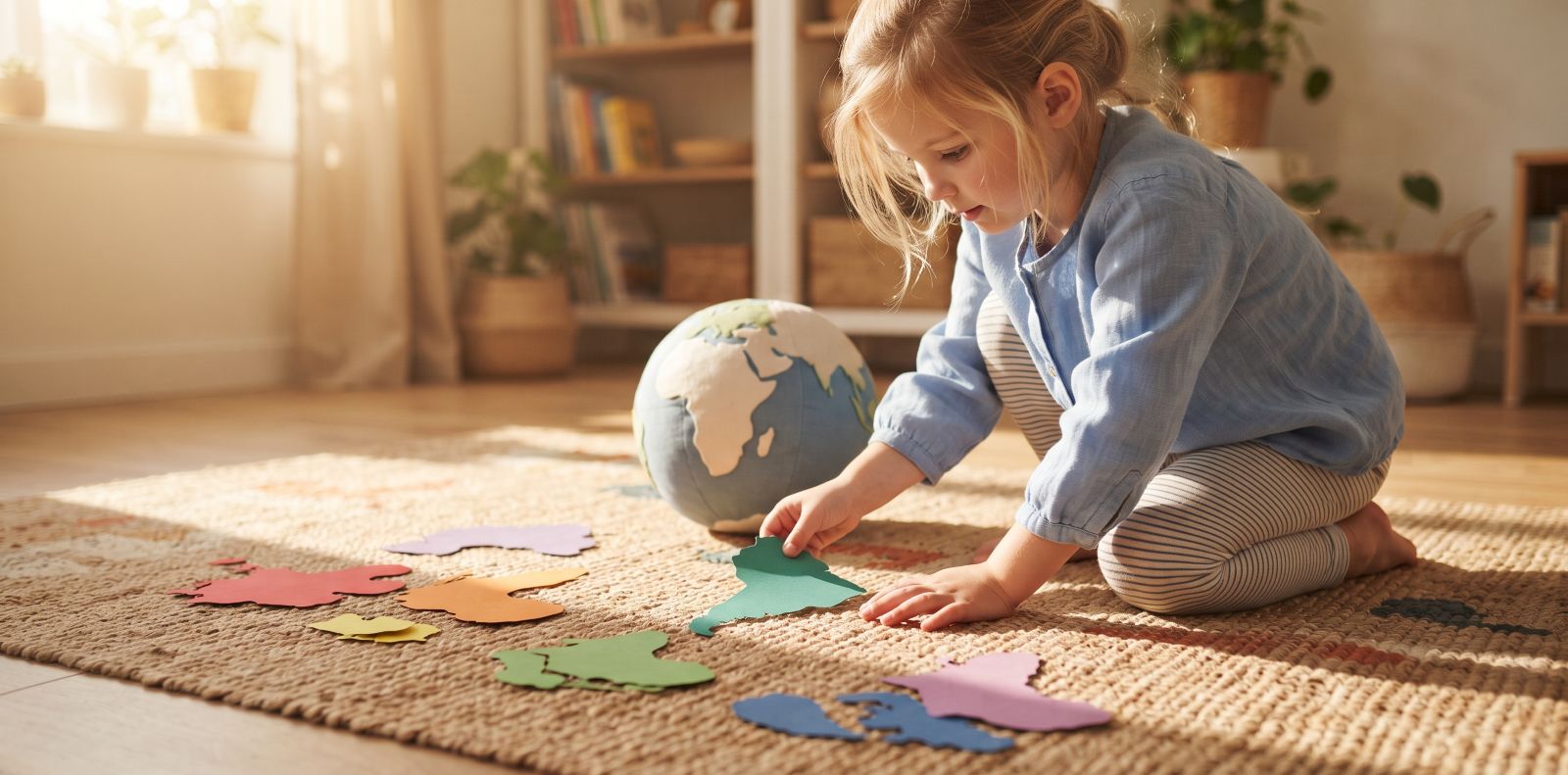
- Use a globe and paper cut-outs. Cut seven shapes from colored paper, one color per continent, and let your child place each one on a floor map or beside a globe. Sorting by color helps memory.
- Learn two or three at a time. Four-year-olds often do well with the biggest and the most different ones (Asia, Antarctica, Australia). Add the rest over several weeks.
- Pair each continent with one story or picture. A penguin for Antarctica, a kangaroo for Australia, a pyramid for Africa: one picture is easier to remember than a list of facts.
- Color and revisit. Coloring a flag or a country page gives children a reason to look closely and come back. Our article on how geography coloring pages compare with textbooks explains why this works for this age, and coloring flags builds fine motor skills at the same time. Flags are also a friendly way into map reading, as shown in flag colors and early map reading.
Continents in a coloring series
Children of the World and Their Cultures is a five-book coloring series that travels through the world one continent at a time: Europe, Africa, Asia, the Americas, and Oceania and the Arctic. Across the series there are more than 116 countries and regions, and each has a coloring page of a child in traditional dress, a landmark scene, and a flag with its own color swatch guide. The books do not cover Antarctica.
If you would like to start with the continent your family knows best, Vol. 1: Europe has 25 countries. For a very different landscape, Vol. 5: Oceania & Arctic is a good second step. You can see the whole series on the series page and try sample pages first from our free samples.
Disclosure: Alex Herek is the publisher of these books. You can find all titles on the Amazon author page.
Frequently asked questions
How many continents are there? Seven, according to National Geographic Education: Asia, Africa, North America, South America, Antarctica, Europe and Australia. Europe and Asia share one landmass, Eurasia, but geographers count them as two continents.
What is the biggest and the smallest continent? Asia is the largest and Australia is the smallest.
Is Oceania a continent? The name Oceania is often used for Australia, New Zealand, New Guinea and the islands of the Pacific. National Geographic lists the seven continents with Australia as the continent, and notes that Oceania can also mean the many Pacific islands.
How many oceans are there? Five are generally named: Pacific, Atlantic, Indian, Southern and Arctic. They are all parts of one connected global ocean.
What age can children start learning the continents? Many children enjoy hearing the names and finding one or two continents on a globe from about age 4. Learning the whole list and the oceans is a realistic goal over several weeks for ages 5 to 8.
Key takeaways
- There are seven continents: Asia, Africa, North America, South America, Antarctica, Europe and Australia.
- Asia is the largest, Australia the smallest, and Antarctica has no countries.
- The five oceans are parts of one global ocean.
- Children learn best with one or two continents at a time, using a globe, paper shapes and coloring.
Sources
- Continent, National Geographic Education (seven continents, sizes, Antarctica, Australia and Oceania, Eurasia).
- How many oceans are there?, NOAA National Ocean Service (one global ocean, five named oceans, the Southern Ocean).
Haven't tried the series yet?
Grab a free 5-page sample from "Children of the World."