
How Coloring Country Flags Builds Fine Motor Skills Before Kindergarten
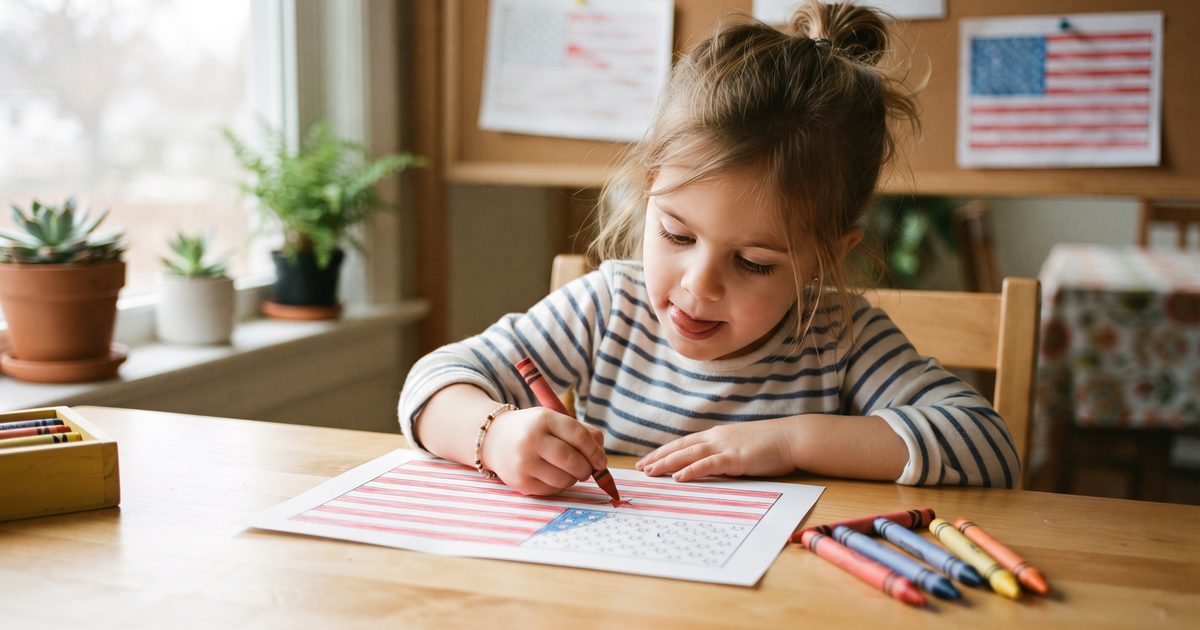
Most preschool coloring pages are forgiving. A lion’s mane, a cloud, a splash of ocean — the outline is curved and wide, so a little wobble outside the line barely shows. A flag doesn’t offer that grace. Straight edges, sharp corners, and a narrow stripe or star leave nowhere to hide an unsteady hand — which is exactly why they’re such a useful, if slightly sneaky, kindergarten-readiness drill.
Why flags ask more of a preschooler’s hand
Kindergarten teachers generally look for a handful of specific hand skills by the time a child walks in the door: a comfortable pencil grip, the ability to stay roughly inside a boundary, and enough control to slow down at a corner instead of sweeping through it. Most open, curved coloring pages don’t actually demand much corner control. A flag does — repeatedly, on the same page, in miniature. That mismatch between what a flag page asks and what a three- or four-year-old’s hand can currently do is precisely what makes the practice count.
The skill-by-skill breakdown
- Grip control. Straight lines take a firmer, more deliberate hold than loose scribbling — the same grip strength handwriting will later require.
- Staying inside a boundary. A flag’s hard edges give immediate, visible feedback the moment a line drifts outside them, which is harder to get away with than on a fuzzy cloud.
- Corner turning. Stopping and redirecting at a 90-degree angle — around a star point or a stripe’s edge — trains the stop-and-pivot motion handwriting depends on.
- Small-space filling. A narrow stripe or a single star is too small for big arm sweeps; it forces isolated finger and wrist movement instead.
- Pattern repetition. Many flags repeat stripes or shapes across the page, building the visual-motor planning that comes from doing the same small motion several times in a row.
A simple way to use flag pages at home
- Start big and simple. Pick a flag with few colors and large blocks of color before moving to ones with stars, seals, or fine detail.
- Work one shape at a time. Largest area first, smallest last — it keeps the page from feeling overwhelming.
- Let the wrist rest on the table. A stabilized wrist makes straight lines dramatically easier than a hand held in the air.
- Don’t correct a wobbly line. The point isn’t a perfect flag — it’s the repeated motion. Control improves with practice, not with a redo.
- Raise the difficulty gradually. As a page or two gets easier, move on to flags with more stripes, smaller stars, or added detail.
Every volume of Children of the World and Their Cultures includes a full page of national flags for each country it covers, arranged so the detail level builds naturally as a child works through a region — a built-in way to keep this practice going without hunting down a new printable every week.
What to expect before kindergarten
Most kindergarten-readiness checklists ask for a workable pencil grip and the ability to color mostly within lines by school entry — not perfection, just a functioning baseline. A flag page a week or two in the year before school starts gives a child concentrated, low-pressure practice at exactly that baseline, without it ever feeling like a drill.
Try it yourself
Hand your child a flag with one simple shape — a single stripe, a plain star — and time how long they stay on the page without you prompting them to keep going. Try a slightly more detailed flag the following week. The extra minute or two they stick with it is the fine motor control building in real time.
Frequently asked questions
At what age should kids start coloring flags for fine motor practice? Around age 3, once a child can hold a crayon with some intention, simple flags with large color blocks are a good starting point. More detailed flags — smaller stars, thinner stripes — suit ages 4–5, closer to kindergarten entry.
How is coloring a flag different from regular coloring pages? Flags have straight edges and sharp corners instead of curved, forgiving outlines, which demands more precise grip control, corner turning, and small-space filling — all skills that generic coloring pages practice less directly.
How often should a preschooler practice this? A few minutes, two or three times a week, is enough. Consistency matters more than session length — short, repeated practice builds hand control faster than one long, tiring sitting.
Haven't tried the series yet?
Grab a free 5-page sample from "Children of the World."