
The Story Behind National Flags: A Kid-Friendly Guide to Colors and Symbols
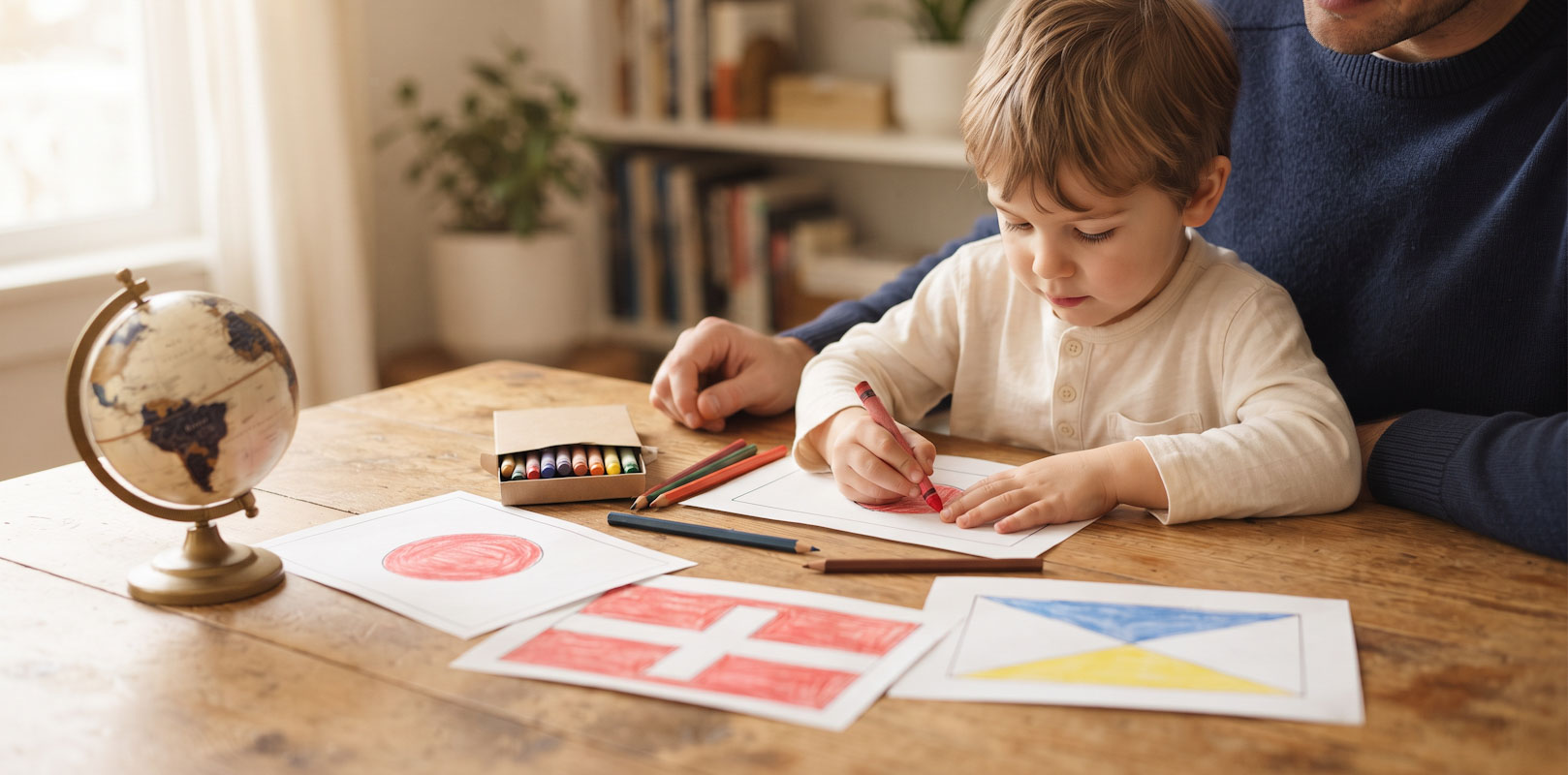
Quick answer: A national flag’s colors and symbols are chosen by the country itself, so there is no single code that works for every flag. Red does not always mean the same thing, and a cross or a star can stand for very different ideas. The story behind a flag, whether a legend, a sunrise, or a mountain range, is what turns “color this flag” into a small history lesson your child will remember.
Flags are chosen on purpose, not by accident
It is tempting to teach children that each color has one fixed meaning, but real flags are more interesting than that. Every country decides for itself what its flag shows and what the parts stand for, and the explanations can be official, traditional, or debated. A good habit for parents and teachers is to say, “This is what the country says about its flag,” instead of “This color always means this.”
Here are three flags with very different stories.
Three flags, three stories
Japan: the circle of the sun
Japan’s flag is called the Hinomaru, which means “circle of the sun.” It is a red circle on a plain white background, and the red circle stands for the sun. According to Kids Web Japan, the design reflects Japan’s position at the western edge of the Pacific Ocean, where the sun rises over the sea to the east. The flag was formally set in law in August 1999, when Japan passed its National Flag and Anthem Law.
Denmark: the flag that “fell from the sky”
Denmark’s flag, the Dannebrog, is a white cross on a red field. A famous legend says it fell from heaven during a battle in 1219, in what is now Estonia, and helped the Danish army win. The official Danish website says plainly that the falling-flag story has no basis in reality, and that historians first wrote it down in the early 16th century. The flag became a Danish flag around the middle of the 14th century, which makes it one of the oldest national flags still in continuous use. Since 1913, Denmark has celebrated the legend on June 15.
Nepal: the flag that is not a rectangle
Nepal is the only country in the world whose flag is neither a rectangle nor a square. It is made of two stacked triangular pennants, a shape with old roots in South Asia. Each pennant carries a white symbol: a crescent moon on the top and a sun on the bottom. The crimson color is Nepal’s national color, reportedly taken from the rhododendron that grows in the Himalayas, and the deep blue border is meant to stand for peace. Nepal’s government says the two pennants represent Hinduism and Buddhism, and other explanations, such as the Himalayan peaks, have also been suggested.
At a glance
| Flag | What you see | A story to tell |
|---|---|---|
| Japan | Red circle on white | The circle stands for the sun rising over the sea |
| Denmark | White cross on red | A legend of a flag falling from heaven, and one of the oldest flags still in use |
| Nepal | Two stacked triangles, moon and sun | The only national flag that is not a rectangle or square |
Why so many flags look simple
You may have noticed that these three flags have very few colors and shapes. The North American Vexillological Association, a group that studies flags, lists five principles of good flag design: keep it simple enough for a child to draw from memory, make the symbols meaningful, use only a few basic colors, avoid lettering and seals, and make it distinctive. That is one reason flags work so well for coloring. A child can look, color, remember, and even redraw them.
How to turn coloring time into story time
- Color the flag first. Let your child enjoy the colors before you talk about any meaning.
- Ask what they see. “What shapes are on it? Which one is your favorite?”
- Share one short story. Choose one fact, such as the Danish legend or Nepal’s unusual shape, and leave the rest for another day.
- Say where the meaning comes from. Use phrases like “Japan says this circle stands for the sun.”
- Invite a design. Ask your child to invent a flag for your family using only two or three colors and one symbol.
If you want ready-made flag pages, every country in Children of the World and Their Cultures includes a flag to color with its own small color swatch guide, so children know which colors go where. For more ideas, see how coloring flags builds fine motor skills and how flag colors can help with early map reading.
Frequently asked questions
Does each color always mean the same thing on every flag? No. Each country decides what its flag’s colors and symbols stand for, and the same color can mean different things in different places. It is best to share the meaning that the country itself gives.
What age can children start learning about flag symbols? Around ages 4 to 5, children usually enjoy hearing one short story per flag while they color. Older children can compare two flags and talk about why they look different.
Where can I find the meaning of a flag? Look for the country’s official government or tourism website, or a trusted encyclopedia. If sources disagree, as they do for some flags, tell your child that people explain it in more than one way.
Do I need to teach the meaning for every flag my child colors? Not at all. One short story per coloring session is plenty, and coloring itself is a good activity even with no story attached.
Sources
- Society: Government FAQ, Kids Web Japan (Japan’s flag and the 1999 law).
- 800 years of Dannebrog, denmark.dk (the 1219 legend and the flag’s age).
- What’s with the funny shape of Nepal’s flag?, The World from PRX (Nepal’s flag shape and symbols).
- Good Flag, Bad Flag, North American Vexillological Association (five principles of flag design).
Haven't tried the series yet?
Grab a free 5-page sample from "Children of the World."