
Daily Life of Kids Around the World: A Parent's Guide to School, Food and Play
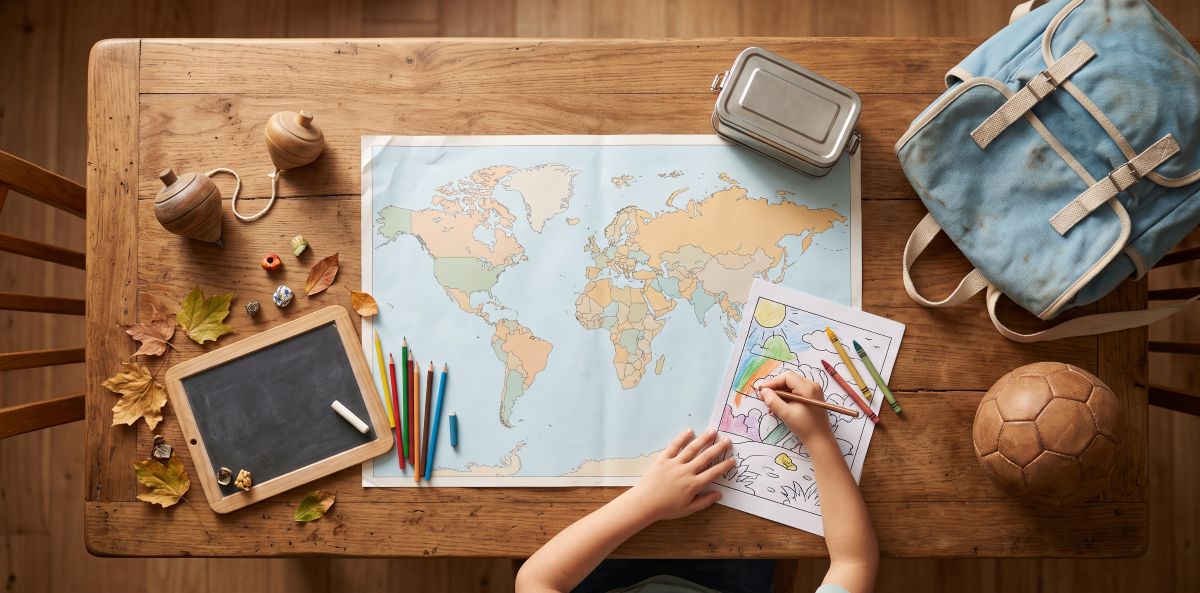
Quick answer: Children everywhere go to school, eat, play and help at home, but the details differ a lot. In Japan, pupils serve school lunch to classmates and clean up afterwards. In Finland, every pupil gets a free hot meal each school day. In parts of Kenya, many children walk several kilometers to school. In Brazil, many schools run short shifts of about four hours. In outback Australia, children have long learned by two-way radio and today by online lessons. These are five snapshots, not the whole story of any country, and they are a good way to start a conversation with your child.
Telling a child that “kids live differently in other countries” is abstract. A concrete scene, such as “this girl walks an hour to school”, is something a child can picture, ask about and compare with their own day. Here are five scenes, one per continent.
5 snapshots of everyday childhood
1. Asia, Japan: lunch is a class job
In many Japanese schools, lunch is called kyushoku, and pupils serve it to their classmates and clean up afterwards. According to the Japan Society, a school that still prepares its own lunches sees this routine as a way to teach manners, responsibility and nutrition. Not every school works this way, but the idea of sharing the work of the meal is a lovely one to talk about.
2. Europe, Finland: a free hot lunch for everyone
Finland was the first country to serve free school meals, with nationwide free catering starting in 1948. Under the Basic Education Act, every pupil is entitled to a free, balanced and supervised meal on every school day. The Finnish Food Authority describes a model plate: vegetables on half of it, potatoes, rice or pasta on a quarter, and fish, meat or a vegetarian alternative on the rest, with milk or water, bread and berries or fruit. A school lunch should cover about one third of a child’s daily food intake.
3. Africa, Kenya: the long walk to school
At Mwangala Primary School in Mombasa County, about 70% of pupils come from more than 5 km away, and many walk 7 to 10 km, according to the Global Partnership for Education. One Grade 5 pupil walks about an hour each way, and many children arrive hungry because the school provides no lunch. This is one school, not all of Kenya, but it shows how much the way to school can shape a child’s day.
4. South America, Brazil: school in shifts
Most public and many private schools in Brazil run two to three shifts of about four hours each, so a child may go to school in the morning and be home before lunch, while another group uses the same classrooms in the afternoon. The Christian Science Monitor reported that in Rio de Janeiro about 16% of municipal schools (165 of 1,004) were full eight-hour schools. Ask your child: when would you like your school day to be, morning or afternoon?
5. Oceania, Australia: school by radio
The School of the Air began in Alice Springs in 1951 as a branch of the Royal Flying Doctor Service, and it is considered a world first. Children living hundreds of kilometers from the nearest school joined live lessons over two-way radio, supported by correspondence work. Today it mainly uses online platforms. The idea came from Adelaide Miethke, who hoped to “bridge the lonely distance” of the outback.
At a glance
| Continent | Country | One everyday detail | Good question for kids |
|---|---|---|---|
| Asia | Japan | Pupils serve lunch and clean up | What jobs do we do at home after a meal? |
| Europe | Finland | Free hot lunch for every pupil | What would your ideal school lunch plate look like? |
| Africa | Kenya | Long walk to school for many pupils | How would you feel after an hour’s walk? |
| South America | Brazil | School day in shifts of about 4 hours | Morning or afternoon school, which would you pick? |
| Oceania | Australia | Lessons by radio, now online | How could you learn if school were far away? |
How to talk about differences without stereotypes
- Say “some” and “many”, not “all”. One school is not a whole country.
- Look for the similarity first. Every child eats lunch, plays and learns; only the details change.
- Avoid “better” and “worse”. Ask “how is it different?” and “why might that be?” instead.
- Use a map. Find each place together; our guide to the seven continents for kids helps.
For more ideas, see our guides on introducing toddlers to world cultures and teaching empathy by meeting children from around the world.
Learn more with coloring books
If your child likes these stories, our Children of the World and Their Cultures series invites kids to explore cultures through coloring, one continent at a time. Start with Volume 3: Asia or Volume 2: Africa. You can also try a free sample first.
Disclosure: Alex Herek is the publisher of these books. You can find all titles on the Amazon author page.
Frequently asked questions
How do children live in different countries? Children everywhere go to school, eat, play and help at home, but routines differ: who serves lunch, how far they travel to school, how long the school day is and how lessons are delivered.
What is a school day like in other countries? It depends on the country and even on the school. In Japan pupils serve lunch, in Finland lunch is free for everyone, in Brazil many schools run four-hour shifts, and in the Australian outback some children learn through the School of the Air.
Which country has free school lunches? Finland has offered free school meals nationwide since 1948, and every pupil in basic education is entitled to one each school day. Other countries also provide school meals, in different ways.
How can I teach my child about other cultures without stereotypes? Use specific examples instead of generalizations, say “some” and “many”, look for similarities first and let children ask their own questions.
What age is this guide for? It works well for ages 5 to 9, read together with a parent or teacher.
Key takeaways
- Everyday life, from lunch to the trip to school, is a friendly way to introduce other cultures.
- One school or one region is an example, not the whole country.
- Start with what is the same, then explore what is different.
- Maps, questions and coloring make the lesson concrete and screen-free.
Sources
- School Lunch, Japan Society (Japan).
- School meals in Finland, Finnish Food Authority (Finland).
- A long way to school in Kenya, Global Partnership for Education (Kenya).
- Double shifts and lousy hours: Are Brazil’s schools holding it back?, The Christian Science Monitor (Brazil).
- Bridging the distance: School of the Air, National Archives of Australia (Australia).
Haven't tried the series yet?
Grab a free 5-page sample from "Children of the World."