
What Are the 12 Dishes of Polish Christmas Eve (Wigilia)?
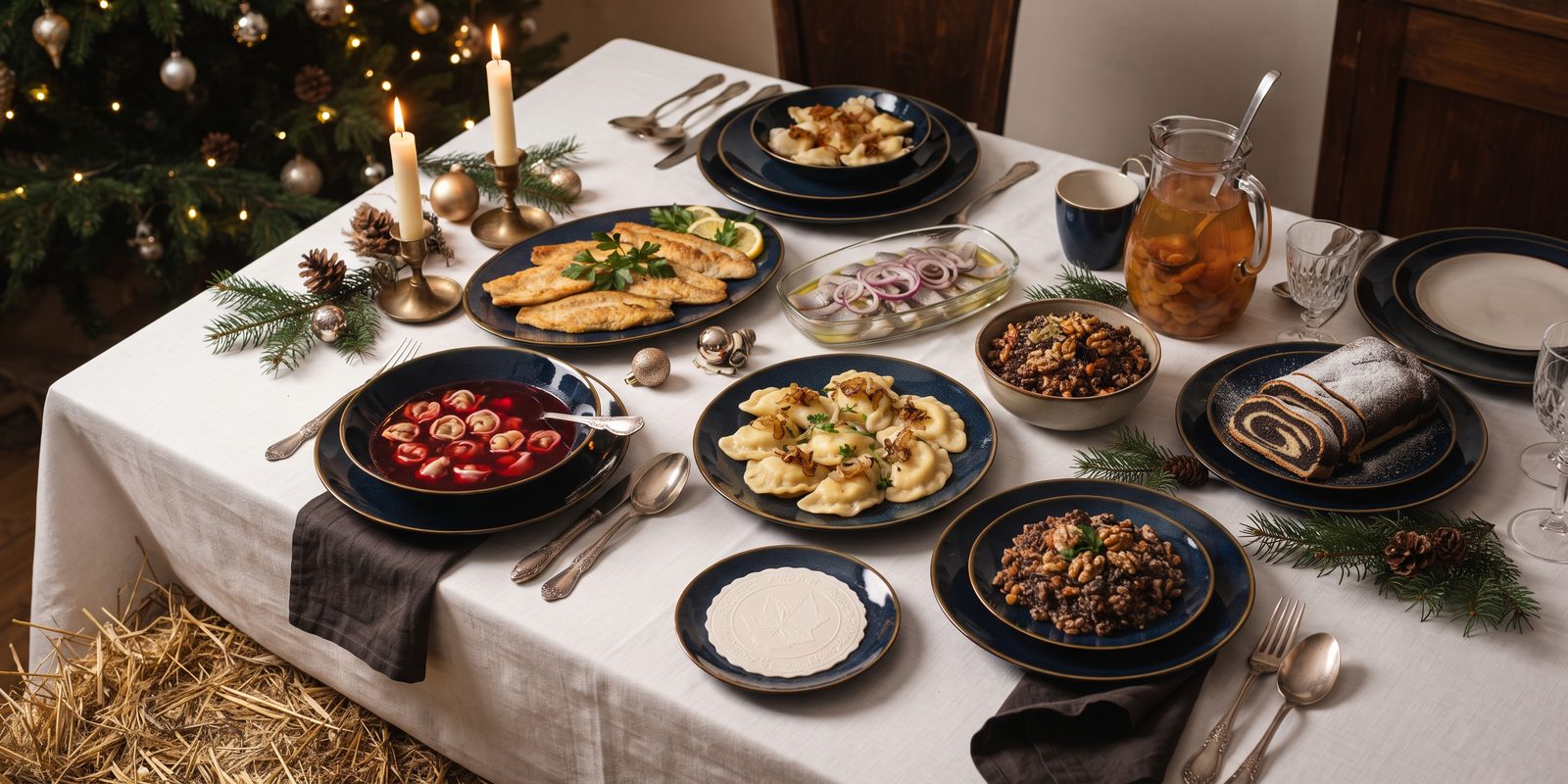
A traditional Polish Christmas Eve dinner, called Wigilia, is a meatless feast of twelve dishes built from fish, mushrooms, cabbage, grains, poppy seed, honey and dried fruit. There is no single official list of the twelve. Most tables include red barszcz, a clear beet soup, with uszka, tiny mushroom dumplings; fried carp; herring; pierogi; and sweets such as makowiec, a poppy seed roll, and kutia, a wheat-berry pudding. The exact menu changes from region to region and from family to family.
This article is part of our Wigilia series. If you are new to the tradition itself — the first star, the extra place setting, the shared wafer — start with What Is Wigilia? A Complete Guide to Polish Christmas Eve Traditions.
Quick answer
- How many dishes? Traditionally twelve, though older customs favored an odd number (7, 9 or 11).
- Why twelve? Most often explained as one dish for each apostle, or one for each month of the coming year.
- Is there meat? No. Wigilia grew out of the Christmas Eve fast, so the menu is meatless.
- Which dishes are essential? Barszcz with uszka, carp, herring, pierogi and at least one poppy seed dessert appear on most Polish tables.
- Must you eat everything? Custom says you should taste every dish, for luck in each month of the new year.
A typical 12-dish Wigilia menu
The table below shows one widely recognized set of twelve dishes. Treat it as a representative example, not a rulebook — Polish families swap dishes freely according to region and family habit.
| # | Dish | What it is | Course |
|---|---|---|---|
| 1 | Barszcz with uszka (beet soup with mushroom dumplings) | Clear, tangy red beet broth served with small dumplings filled with dried mushrooms | Soup |
| 2 | Grzybowa (wild mushroom soup) | Soup made from dried forest mushrooms, often served instead of or alongside barszcz | Soup |
| 3 | Fried carp (karp) | Carp fillets dredged in flour or breadcrumbs and pan-fried | Fish |
| 4 | Fish Greek-style (ryba po grecku) | Fried white fish under a sweet-sour topping of carrots, onion and tomato; a Polish classic despite its name | Fish |
| 5 | Herring (śledzie) | Pickled herring in oil with onion, or in sour cream with apple | Fish |
| 6 | Pierogi with sauerkraut and mushrooms | Boiled dumplings with a savory filling of sauerkraut and dried mushrooms | Main |
| 7 | Sauerkraut with peas | Braised sauerkraut with yellow split peas | Side |
| 8 | Poppy seed noodles (kluski z makiem) | Noodles tossed with sweetened poppy seed, honey and dried fruit | Sweet |
| 9 | Kutia (wheat-berry pudding) | Cooked wheat berries with poppy seed, honey and nuts, typical of eastern Poland | Sweet |
| 10 | Makowiec (poppy seed roll) | Yeast cake rolled around a thick poppy seed filling | Dessert |
| 11 | Piernik (gingerbread cake) | Spiced honey cake, often layered with plum jam | Dessert |
| 12 | Kompot (dried-fruit compote) | Sweet drink simmered from dried apples, pears, plums and figs | Drink |
A few notes that help when reading this list:
- Soups come first. Barszcz is the most common opening, served in a cup or bowl. In many homes grzybowa, a wild mushroom soup, stands in for it; in others both appear.
- Fish is the centerpiece. Carp became the defining Wigilia fish in 20th-century Poland, largely because state fish farms made it widely available after World War II. Pike, cod and trout are common substitutes, especially outside Poland.
- The drink counts. Kompot is often counted as one of the twelve, which is why it appears on so many lists.
Why twelve dishes?
The most common explanation links the twelve dishes to the twelve apostles. A second, folk explanation ties them to the twelve months: taste every dish and each month of the coming year will bring good fortune.
Older Polish customs, however, placed more weight on an odd number of dishes than on twelve specifically. A frequently repeated rule of thumb held that peasant tables served seven dishes, gentry tables nine and aristocratic tables eleven. The number shifted with wealth and social rank, while the meatless, fasting character of the meal stayed the same.
That contrast — one tradition, very different tables — is the organizing idea of our cookbook. Wigilia: A Polish Christmas Cookbook of Three Tables follows the feast through the peasant, manor and royal tables of Poland and closes each of those chapters with a ready-to-use 12-dish menu. See the book on its page.
Why is the Wigilia menu meatless?
Wigilia developed as the final evening of the Advent fast, so meat was excluded from the table. That is why the menu relies on:
- Fish — carp, herring, pike, cod
- Mushrooms — mostly dried forest mushrooms such as porcini
- Cabbage and sauerkraut
- Grains and legumes — wheat berries, buckwheat, peas, beans
- Poppy seed, honey, nuts and dried fruit
These are also the foods a village household would have had in storage in late December: dried, pickled or preserved from the autumn harvest. The meatless custom remains the norm in Polish homes today, and meat dishes wait until Christmas Day.
How the 12 dishes change by region
No two Polish regions build the twelve in exactly the same way. Some well-known regional variations:
- Silesia — a sweet dessert soup thickened with gingerbread and dried fruit, and makiełki, a poppy seed dessert made with bread or noodles.
- Podlasie and eastern Poland — kutia is essential, and forest mushrooms appear in many courses.
- Kashubia — dishes built on local fish and staples such as potatoes, including an old hemp seed soup.
- Mazovia — herring and buckwheat groats play a prominent role.
- Podhale (the Tatra highlands) — a sour mushroom and sauerkraut broth often replaces barszcz.
We will look at each region in detail in a separate article in this series.
Wigilia table etiquette: how the dishes are served
The dishes are not served at random. The meal usually follows this order:
- Opłatek first. Before anyone eats, the family breaks and shares opłatek, a thin unleavened wafer, exchanging wishes for the new year.
- Soup. Barszcz with uszka or mushroom soup.
- Fish and savory dishes. Carp, herring, fish Greek-style, pierogi, sauerkraut with peas.
- Sweets and dessert. Kutia, poppy seed noodles, makowiec, piernik.
- Kompot is on the table throughout the evening.
Portions stay small on purpose. With twelve dishes and the custom of tasting each one, the evening is meant to be long and unhurried.
How to adapt the 12 dishes outside Poland
If you are cooking Wigilia in the United States, the United Kingdom or elsewhere, a few simple swaps keep the menu authentic:
- No live or fresh carp? Use trout, cod or another firm white fish.
- No Polish dried mushrooms? Dried porcini are the closest substitute.
- Short on time? Buy good sauerkraut and store-bought poppy seed filling, and spend your time on the uszka and pierogi.
- Vegan guests? Barszcz, mushroom soup, sauerkraut with peas, pierogi with a sauerkraut filling and kompot are naturally plant-based or easy to adapt.
Key takeaways
- Wigilia, the Polish Christmas Eve dinner, traditionally has twelve meatless dishes.
- Twelve is linked to the apostles or the months of the year; older customs used an odd number tied to social rank.
- The core dishes are barszcz with uszka, carp, herring, pierogi and poppy seed desserts.
- The menu varies by region and family — there is no single official list.
- Tradition says to taste every dish for good luck in the new year.
Coming next in this series: Traditional Polish Christmas Recipes — barszcz, pierogi, kutia and makowiec, step by step.
Frequently asked questions
What are the 12 dishes of Polish Christmas Eve?
There is no single official list. A typical Wigilia menu includes red barszcz (beet soup) with uszka (mushroom dumplings), mushroom soup, fried carp, fish Greek-style, herring, pierogi with sauerkraut and mushrooms, sauerkraut with peas, poppy seed noodles, kutia, makowiec (poppy seed roll), piernik (gingerbread cake) and dried-fruit compote. The exact set varies by family and region.
Why are there 12 dishes at Wigilia?
The number twelve is most often linked to the twelve apostles, and sometimes to the twelve months of the year, with each dish bringing luck for one month. Older customs favored an odd number of dishes instead, and many families still serve seven, nine or eleven.
Is Polish Christmas Eve dinner meatless?
Yes, traditionally. Wigilia comes from the Christmas Eve fast, so the menu is built on fish, mushrooms, cabbage, grains, poppy seed, honey and dried fruit. Meat returns to the table on Christmas Day.
Do you have to eat all 12 dishes?
By custom, guests should at least taste every dish on the table, because each one is said to bring good fortune in the coming year. Portions are small for that reason.
What is the most important Wigilia dish?
Most Polish families would name red barszcz with uszka and fried carp as the heart of the meal, but the ritual starts before any dish, with the sharing of opłatek (Christmas wafer).
Want the full A Polish Christmas Cookbook of Three Tables?
150 recipes, three historic tables, six regions of Poland.