
Non-Dominant Hand Drawing: How Neuroplasticity-Inspired Exercises Support Brain Fitness
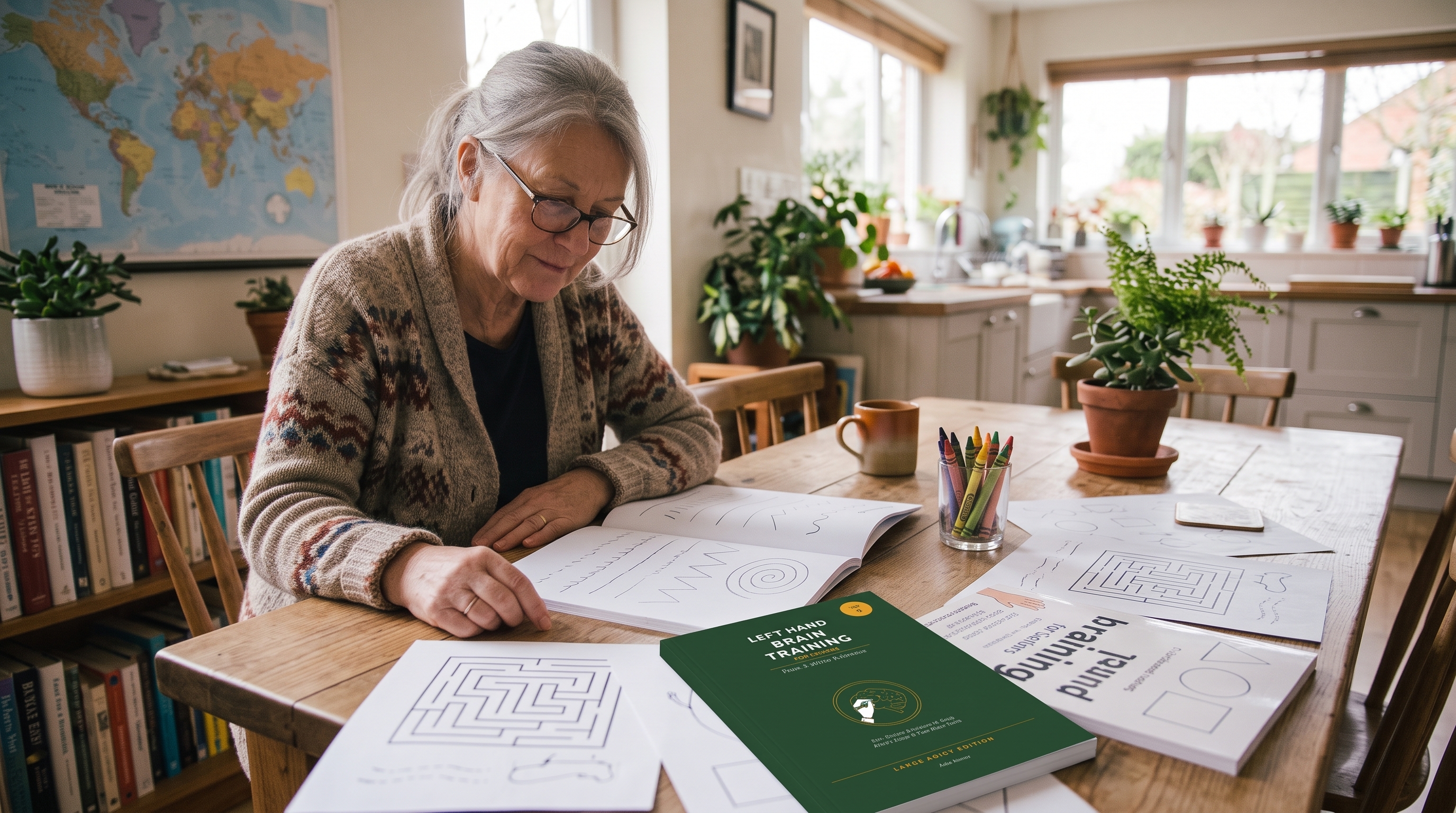
Non-dominant hand drawing is the practice of intentionally writing or drawing with your less-used hand — a simple, screen-free brain-fitness habit inspired by the general concept of neuroplasticity, the brain’s capacity to adapt to new and unfamiliar demands. It isn’t a medical exercise or a treatment for any condition; it’s a low-cost, low-pressure way to introduce a little novelty into a daily routine.
Pick up a pencil with the hand you don’t normally write with, and something odd happens almost immediately: lines wobble, letters slow down, and a task you’ve done on autopilot for sixty-plus years suddenly asks for your full attention. For many people, that shift in attention — and the small fine-motor coordination challenge that comes with it — is exactly what makes the habit satisfying.
What happens when you draw with your non-dominant hand
Most of us haven’t consciously thought about handwriting in decades — the dominant hand does it automatically, without much attention required. Switching to the other hand removes that autopilot. Every stroke has to be planned instead of assumed, which is why even a straight line can suddenly feel like a small puzzle.
That shift in attention is the appeal, not a side effect to push through. Occupational and cognitive researchers have long been interested in how the brain responds to unfamiliar motor tasks, and neuroplasticity — the brain’s general, well-documented ability to adapt with practice and novelty — is often cited as the inspiration behind activities like this one. Left Hand Brain Training doesn’t claim to treat or prevent any condition; it’s designed as an engaging, low-stakes way to build a small daily habit around trying something your dominant hand normally handles without a second thought.
Familiar hand vs. non-dominant hand, side by side
| Dominant hand | Non-dominant hand | |
|---|---|---|
| Attention required | Mostly automatic | Requires active, moment-to-moment focus |
| Pace | Fast, practiced | Slower, more deliberate |
| Line control | Smooth, predictable | Wobblier at first, steadies with repetition |
| Novelty | Low — decades of practice | High — genuinely unfamiliar territory |
| Sense of accomplishment | Rarely noticed | Often noticeable line by line, page by page |
How to get started, one exercise type at a time
You don’t need any artistic background — non-dominant hand drawing is about the process, not the finished picture. A structured book helps because it builds difficulty gradually instead of throwing you at a blank page. Left Hand Brain Training for Seniors, Book 1 — First Strokes is organized around six progressive exercise types that build fine motor coordination gradually, and they double as a natural starting sequence for anyone trying this for the first time:
- Straight lines and zigzags — the simplest starting point, building basic pencil control before anything more complex.
- Curves, waves, and spirals — introduces fluid, continuous movement instead of short straight strokes.
- Basic shapes — circles, squares, and triangles, practicing closed forms and corners.
- Simple mazes — adds a light problem-solving element on top of the motor practice.
- Connect the dots — practices precision and planning a path before drawing it.
- Pattern tracing — combines everything into small repeating designs.
Ten to fifteen minutes with one page is plenty for a single sitting — this is meant to be unhurried.

Try it yourself: download a free sample page and see how the guided exercises feel before picking up the full book.
Tips for making it a habit, not a chore
- Keep sessions short. Five to fifteen minutes is enough — this works best as a small daily habit, not a long sitting.
- Use large print and thick guide lines. Straining to see faint lines defeats the purpose; bold, easy-to-follow outlines let you focus on the movement itself.
- Don’t erase and redo. A wobbly line is the point, not a mistake — smoothing it out happens naturally with repetition, not correction.
- Pair it with something else you already do. Right after morning coffee or before an evening show works well as a fixed daily cue.
- Notice progress over weeks, not days. Line control tends to improve gradually — page-to-page comparison is more encouraging than judging a single session.
Frequently asked questions
Do I need to be artistic or already ambidextrous to try this? No. Non-dominant hand drawing is intentionally designed for people who have never used their other hand for anything beyond incidental tasks — the wobble is expected, not a sign you’re doing it wrong.
Is this a medical or therapeutic exercise? No. Left Hand Brain Training is a recreational brain-fitness activity inspired by general neuroplasticity concepts — it is not a medical product, and it doesn’t diagnose, treat, or prevent any condition. Anyone with a specific health concern should talk to a healthcare provider.
How long before I notice a difference? Most people notice their lines steadying within the first few sessions, simply from repetition. This is meant to be an enjoyable, low-pressure habit rather than something measured against a timeline.
What age is this appropriate for? It’s designed with older adults in mind — large print, thick guide lines, and single-sided pages that are easy on the eyes — but the exercises work for any adult curious about trying their non-dominant hand.
Is there a next step after finishing the first book? Left Hand Brain Training is a five-book progressive series, moving from wide lines and simple shapes toward finer paths, mirror-image drawing, and eventually drawing from memory — see the full series for what comes after Book 1. Readers who enjoy word and memory puzzles alongside drawing drills often pair it with Sharp Mind.
Haven't tried the series yet?
Grab a free sample from Left Hand Brain Training for Seniors.