
Geography Coloring Pages vs. Textbooks: Why Visuals Work Better for Ages 3–8
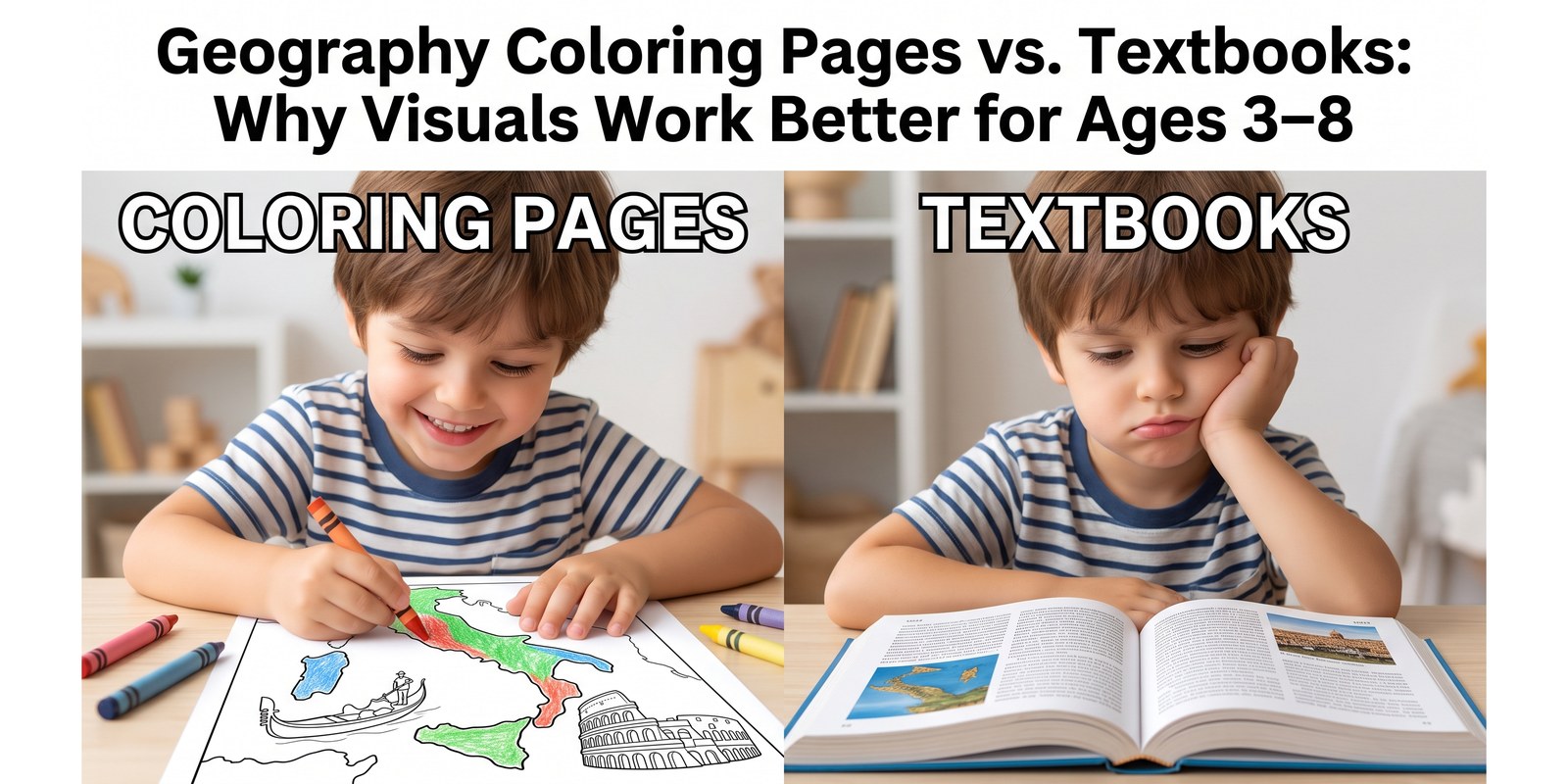
Ask a five-year-old to point to Italy on a map, and you’ll often get a shrug — even ten seconds after you showed them. Ask the same child to color a boot-shaped country while a gondola glides past a paper Colosseum, and three days later they’ll still tell you exactly what shape Italy is. That’s not luck. It’s the difference between looking and doing.
The two side by side
| Coloring Pages | Textbooks | |
|---|---|---|
| How kids engage | Hands, eyes, and attention working together | Eyes only — mostly passive reading or listening |
| Attention span fit (ages 3–8) | Matches a natural 10–20 minute activity window | Often exceeds it, especially for pre-readers |
| Memory anchor | A specific color choice, a specific shape they drew | A sentence they may or may not have processed |
| Entry point for non-readers | None needed — the page speaks in pictures | Requires reading, or being read to |
| Repeat value | Kids often return to a favorite page unprompted | Rarely re-read without adult prompting |
Four reasons the crayon wins, for this age group
- It asks for a decision, not just attention. Choosing which blue to use for a flag is a small act of engagement a textbook page simply can’t ask for.
- It’s self-paced. A child can spend three minutes or thirty on the same page — nobody’s turning the slide before they’re ready to move on.
- It doesn’t require reading. For ages 3–5 especially, a coloring page can teach something well before literacy is part of the picture.
- The finished page becomes proof of learning. Kids tend to remember what they made far longer than what they were simply told.
None of this makes textbooks wrong for this age group — a short fact shared out loud alongside a coloring page gives you the best of both. That’s exactly how each Children of the World and Their Cultures volume is built to be used: a country’s flag, a landmark, and local wildlife to color — ready for you to pair with a fact of your own choosing, on pages a child actually wants to finish.
Try it yourself
Pick one country your child has never talked about before. Read them a sentence or two about it, then hand them a blank outline of its flag and let them choose the colors. Ask what they remember about it a day later. In our experience — and in the way every page in the Europe and Asia volumes is designed — the flag wins almost every time.
Haven't tried the series yet?
Grab a free 5-page sample from "Children of the World."